Press kit
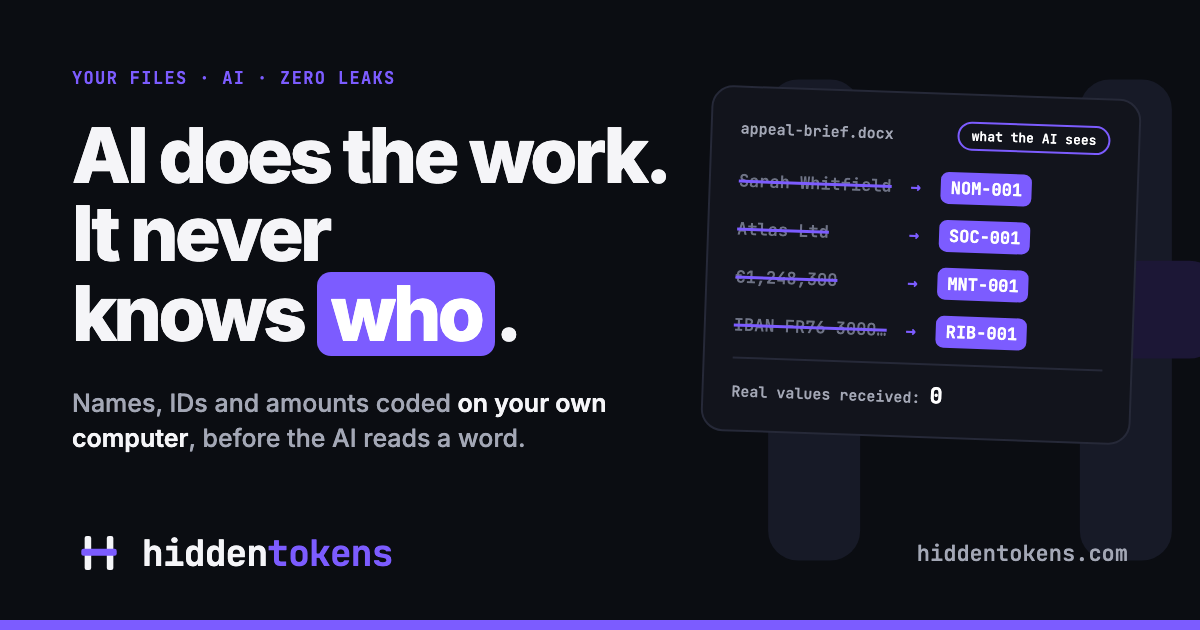
Hidden Tokens replaces the names, identifiers and amounts in a file with codes on the user's own computer, before Claude, ChatGPT or any other AI reads it, and puts the real values back into the result, on the same computer. Everything a journalist needs is on this page; every number has its source.
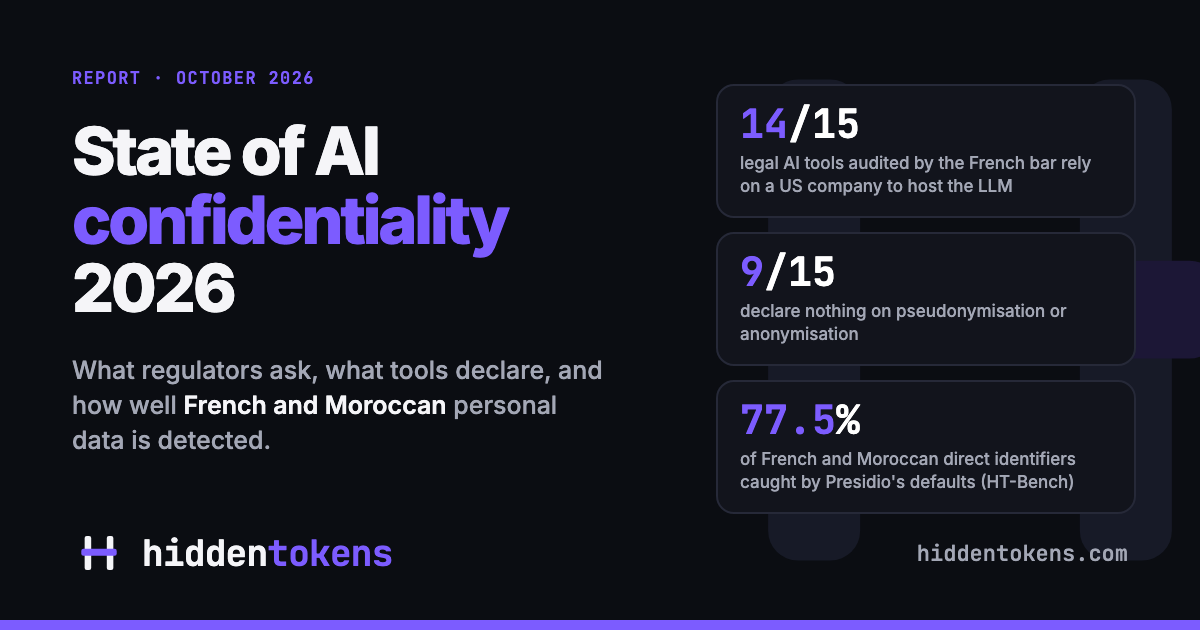
- 14 of 15 legal AI tools summarised in the French National Bar Council's (CNB) 2025 reading grid name a US company among those hosting the language model (CNB AI working group, Grille de lecture, June 2025).
- 9 of 15 of the same tools declare nothing on pseudonymisation or anonymisation, which the CNB's April 2026 ethics guide recommends before using a generative AI tool.
- On 366 synthetic French and Moroccan documents, Presidio's default recognisers detected 77.5% of direct identifiers; Hidden Tokens 2.28.0 detected 100.0%. This is a synthetic benchmark run by Hidden Tokens itself (method and limits).
Download the one-page press kit (PDF) · Kit presse en français
About Hidden Tokens
50 words. Hidden Tokens lets professionals bound by secrecy use generative AI on real files. It codes names, identifiers and amounts on the user's own computer before an AI reads them, then restores the real values in the result. The key never leaves the machine. Mac and Windows; Claude Desktop, ChatGPT, Gemini, Copilot and more.
100 words. Hidden Tokens is a desktop app for lawyers, accountants, HR teams, banks, insurers, telecom operators and healthcare providers who want to use generative AI without handing over their clients' identities. It codes a whole case file on the user's computer — the same client gets the same code in every document — so the AI works on codes such as NOM-001. The result comes back in clear, in Word or Excel, on the same machine. Nothing is sent to Hidden Tokens. Signed proof pages, a client seal and a monthly signed ledger let a DPO or a client check what the AI received. Available on Mac and Windows; 14-day free trial.
Story angles
- The legal AI market fails its own regulator's grid. The French bar asks firms to check where a tool's language model is hosted and whether it pseudonymises. Most audited tools are hosted by US companies and say nothing on pseudonymisation.
- Banning AI doesn't work; pseudonymising does. Staff use AI anyway, often on their phones. The newest answer is reversible pseudonymisation on the workstation, with proof a DPO can check.
- Generic detectors miss local identifiers. On the same benchmark, Presidio's defaults caught 5.5% of Moroccan bank account numbers (RIB) and 1.8% of company names.
- Proof, not promises. A seal a client can verify in a browser, a "What Claude saw" log, and a monthly signed ledger that feeds the GDPR Article 30 record and the EU AI Act deployer file.
All of this is discussed in our annual report, State of AI confidentiality 2026 (page and PDF).
Key facts
| Product | Desktop app (Mac, Windows) with a folder-watching sentinel, a Claude Desktop connector and a browser extension |
|---|---|
| Works with | Claude Desktop (connector); ChatGPT, claude.ai, Gemini, Copilot, Le Chat (Mistral), Perplexity and DeepSeek (Chrome and Edge extension) |
| Industry packs | Legal, accounting, HR and payroll, banking and insurance, healthcare, telecom |
| Data handling | Coding, key and decoding stay on the user's computer; no file, code or key is sent to Hidden Tokens |
| Proof | "What Claude saw" log, signed proof pages, client seal, coverage report, monthly signed Ledger |
| Pricing (excl. VAT) | Solo €30 / month, billed €360 / year · Firm (2–20 seats) and Organisation (21+ seats): on quote, after a 20-minute demo; Organisation from €4,900 / year |
| Trial | 14 days, no account, no card; files already coded stay decodable forever |
| Version | App 0.15.0 (29 October 2026); first official release (v1) planned for January 2027 |
Limits we state ourselves
- HT-Bench is synthetic and run by Hidden Tokens. A perfect score there does not mean every value is caught in real files: addresses, dates of birth and cheque numbers are still missed at times, and the notary pack is not measured yet.
- Text a user pastes into an AI without going through Hidden Tokens is not protected; every proof page says so.
- The Windows installer is not yet signed with a Windows certificate: SmartScreen shows "unknown publisher" on first launch.
Logos and images
- Logo (redacted H) on a light background: SVG · PNG 512 px
- Logo on a dark background: SVG · PNG 512 px
- App icon: PNG 512 px
- Product visual: 1200 × 630 · report cover: 1200 × 630
- Video demo: hiddentokens.com/video/




Meet Hush, our mascot
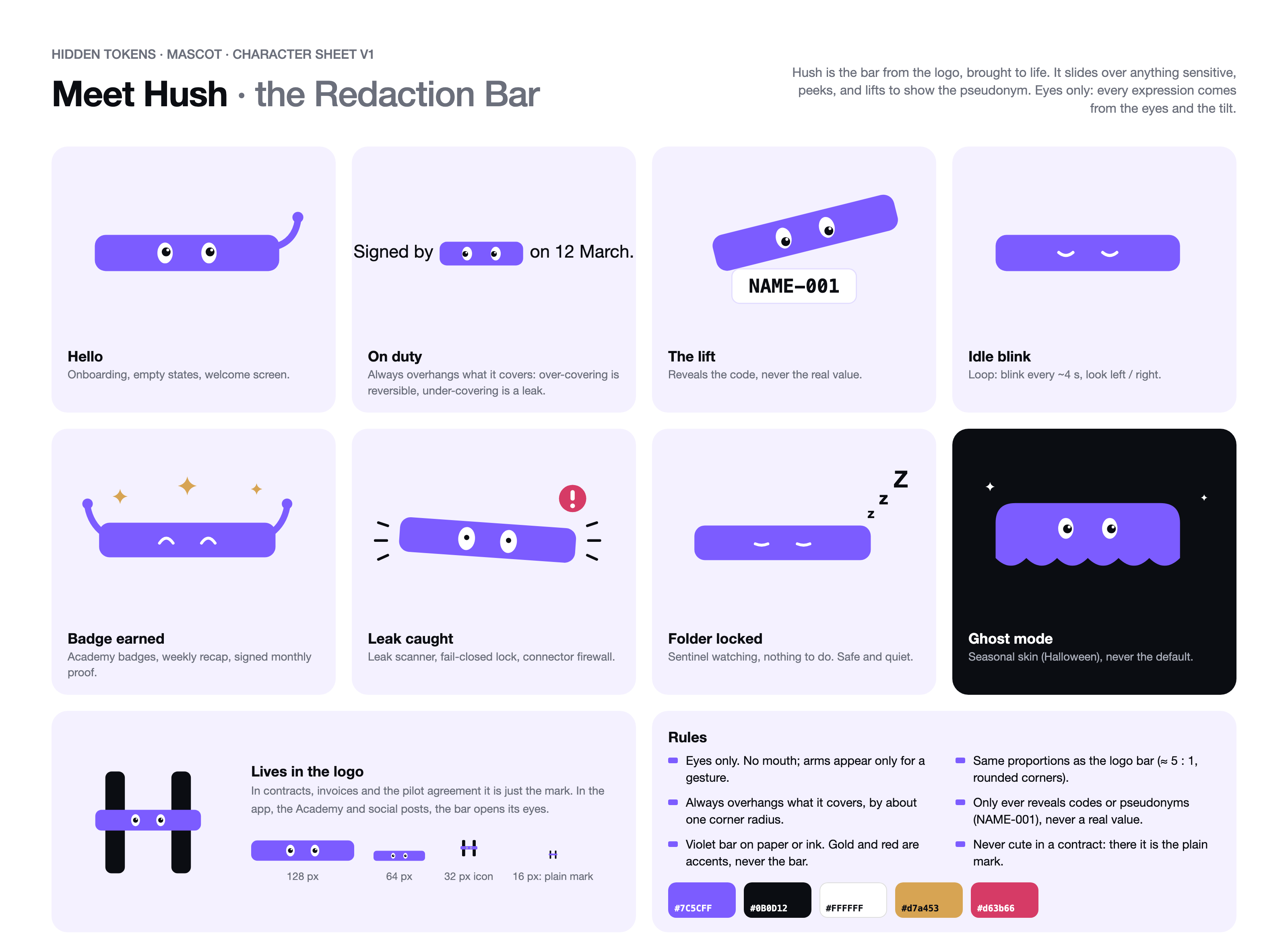
Hush is the violet bar from our logo, with eyes. It slides over anything sensitive, keeps watch, and lifts only to show a code such as NAME-001, never the real value. It always overhangs what it covers: covering too much can be undone, covering too little is a leak.
- Hush on its own: SVG · the logo with Hush's eyes open: SVG
- Character sheet (8 poses and usage rules): PNG
- In contracts and official documents, and below 32 px, we use the plain logo: Hush lives in the app, the Academy and social posts.


Contact
info@hiddentokens.com — interviews, live demos and the full benchmark data on request.
How to cite the report: Hidden Tokens, State of AI confidentiality 2026, edition 1, 25 October 2026, https://hiddentokens.com/state-of-ai-confidentiality-2026/